How the Iran War Is Moving Oil, Stocks, and Bond Yields
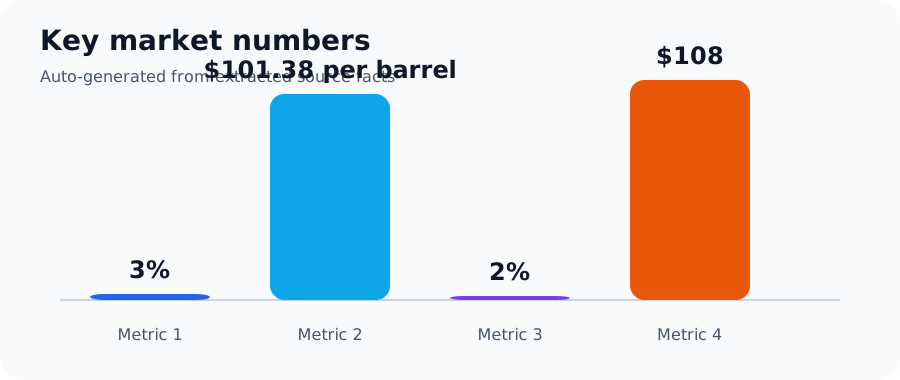
The conflict involving Iran has introduced a period of profound volatility across global markets, fundamentally shifting the trajectory of energy prices and investor expectations for inflation. While the initial shock of the war sent crude oil prices soaring by approximately 57% from the start of the conflict through late April, the market has recently entered a phase of erratic price action. On a recent Friday, U.S. crude oil fell more than 3% to settle at $101.38 per barrel, while the international benchmark Brent dropped about 2% to $108. This downward move, however, may be a deceptive calm rather than a sign of stabilization.
The primary reason for this market resilience—and the subsequent risk of a sharp reversal—lies in a temporary supply buffer that is currently masking the severity of the disruption. As Exxon Mobil CEO Darren Woods recently explained to CNBC, the market has not yet seen the "full impact" of the war because of the large volume of oil tankers that were already in transit when the conflict began. Furthermore, the aggressive release of strategic petroleum reserves and the drawdown of commercial inventories have provided a short-term cushion. Once these "on-the-water" supplies are exhausted and the Strait of Hormuz remains restricted, the structural deficit in global oil supply is expected to exert renewed upward pressure on prices.
For investors, the direct answer to how this war is moving markets is found in the "lag effect" of supply chains. The immediate impact is visible in the 57% rise in raw commodity costs, but the secondary effects are now beginning to ripple through corporate earnings and bond markets. While oil prices have surged, the stocks of major producers like Exxon Mobil have remained relatively flat over the same period. This divergence occurs because the same geopolitical factors driving prices higher—such as the closure of the Strait of Hormuz—are simultaneously strangling the ability of these companies to deliver their products to global refiners, creating a unique environment where high prices do not necessarily translate into higher equity valuations for the energy sector.
The mechanics of supply disruption and the Strait of Hormuz
The most critical factor currently dictating oil prices is the status of the Strait of Hormuz, a narrow waterway that serves as the world's most important oil transit chokepoint. The closure or severe restriction of this route has created an unprecedented disruption in the global supply of oil and natural gas. According to reporting from CNBC, Exxon Mobil has warned that its production in the Middle East could decline by as much as 750,000 barrels per day compared to 2025 levels if the strait remains closed through the second quarter of the year.
This disruption is not just a theoretical risk; it is already impacting the physical flow of energy. Exxon reported that approximately 15% of its total production has been affected by the closure. However, the reason the global economy hasn't felt a total supply collapse yet is logistical. Oil that was loaded onto tankers weeks before the escalation is only now reaching its final destinations in Europe and Asia. This "inventory in transit" acts as a rolling buffer. Darren Woods noted that it typically takes a month or two for oil flows to normalize even after a waterway reopens, as tankers must be repositioned and backlogs worked through.
As these transit volumes diminish, the market will increasingly rely on commercial and strategic inventories. The depletion of these reserves is a "one-time" fix. Once governments and private firms reach the floor of their storage capacity, the market will be forced to price in the actual daily deficit of millions of barrels. This suggests that the recent dip to $101 per barrel may be a temporary reprieve based on current liquidity rather than a reflection of long-term supply-and-demand equilibrium.
Divergence between commodity prices and energy equities
One of the most surprising outcomes of the current conflict is the lack of correlation between rising oil prices and the stock performance of integrated oil majors. Historically, a 57% increase in the price of Brent crude would trigger a massive rally in energy stocks. However, Exxon Mobil’s stock has remained largely flat during this period. This phenomenon is driven by the physical constraints placed on the companies' operations.
When a war shuts down key infrastructure, an oil company loses on volume what it gains on price. For Exxon, the 750,000 barrel-per-day production hit represents a significant portion of its upstream output. Furthermore, the company’s throughput to refiners around the world is expected to fall by 3% compared to the fourth quarter of 2025. When a company cannot move its product to market, it cannot capture the "windfall" profits typically associated with high commodity prices.
Investors are also pricing in the long-term costs of the conflict. Beyond the immediate loss of production, there are the costs of rerouting tankers, increased insurance premiums for maritime shipping, and the potential for damage to fixed assets in the region. This has led to a "risk-off" sentiment within the energy sector itself, where investors prefer the safety of cash or diversified assets over the volatile earnings of companies directly exposed to the Middle Eastern theater.
Inflation pass-through and the pressure on bond yields
The movement in oil prices is the primary engine currently driving bond yields and central bank policy expectations. Energy is a "universal input"; when the price of oil rises, the cost of transporting goods, manufacturing plastics, and heating homes rises in tandem. This creates a direct "pass-through" effect into the Consumer Price Index (CPI).
As oil prices remain sustained above the $100 mark, inflation expectations for the coming quarters have been revised upward. This has a direct impact on the bond market. When inflation is expected to be higher for longer, investors demand higher yields to compensate for the eroding purchasing power of future interest payments. Consequently, we have seen a steady climb in the 10-year Treasury yield, which serves as a benchmark for everything from mortgages to corporate loans.
The "higher for longer" interest rate environment is a direct consequence of the energy shock. Central banks, particularly the Federal Reserve, are forced to maintain restrictive monetary policies to prevent energy-driven inflation from becoming embedded in the broader economy. This creates a difficult environment for stocks outside of the energy sector, as higher yields make equity valuations look more expensive and increase the cost of capital for growth-oriented companies.
Sector vulnerabilities and consumer spending shifts
While the energy sector struggles with volume, other sectors are feeling the direct pressure of higher input costs. The transportation and logistics industries are the first to feel the burn. Airlines, trucking companies, and shipping firms are seeing their fuel surcharges skyrocket, which they must either absorb—thinning their profit margins—or pass on to consumers, which risks dampening demand.
The retail and consumer discretionary sectors are also highly vulnerable. As gasoline prices rise at the pump, household budgets are squeezed. Every extra dollar spent on fuel is a dollar not spent on dining out, electronics, or apparel. This "tax" on the consumer is particularly potent during periods of geopolitical uncertainty when consumer confidence is already fragile.
Furthermore, the manufacturing sector is facing a double-edged sword. Not only are energy costs higher, but the disruption in the Middle East also affects the supply of natural gas, a critical feedstock for the chemical and fertilizer industries. A sustained closure of the Strait of Hormuz could lead to a shortage of essential industrial chemicals, further complicating global supply chains that are still recovering from previous years of instability.
What readers should watch next
The trajectory of the markets in the coming months will depend on three specific variables. First, the status of the Strait of Hormuz remains the "alpha and omega" of the current energy crisis. Any news regarding the reopening of the strait or the establishment of protected shipping lanes will likely cause an immediate, sharp drop in oil prices as the "fear premium" evaporates. Conversely, signs of a prolonged closure will force a repricing of oil toward the $120–$140 range.
Second, investors should monitor the level of global strategic and commercial inventories. The current market is being subsidized by these reserves. When the U.S. and other IEA member nations signal that they can no longer afford to draw down their Strategic Petroleum Reserves (SPR), the market will lose its primary defense against price spikes. A shift from "inventory drawdown" to "inventory refilling" will mark a significant turning point, as governments begin competing with private buyers for limited supply.
Finally, watch the earnings reports of mid-stream and downstream energy companies. While the "upstream" producers are losing volume, the companies involved in storage, alternative transport, and specialized refining may show more resilience. The ability of these firms to adapt to the "new map" of global energy flows will provide a clearer picture of which parts of the market are truly positioned to weather a prolonged conflict in the Middle East.
Final takeaway
The Iran war has created a complex market environment where the headline price of oil does not tell the full story. While prices have surged, the "full impact" has been delayed by logistical buffers and strategic reserve releases that are inherently temporary. The divergence between high commodity prices and flat energy stocks highlights the operational toll of the conflict, while rising bond yields reflect the persistent inflationary pressure of expensive energy. Investors should remain cautious, recognizing that the current volatility is driven by a structural supply deficit that will become more apparent as transit backlogs clear and inventories are depleted.
This article is for educational purposes only and does not constitute financial advice.
How this shock is feeding into oil, inflation expectations, stock performance, bond yields, and the next signals investors should watch.
Stay ahead of the next move
If you found this useful, join the GrowthVisual newsletter for concise market briefings, key numbers, and the next signals to watch.
GrowthVisual Editorial Team reviews and publishes practical market analysis, calculator guides, and personal finance explainers.