Why Markets Are Reacting This Way and What Investors Should Watch
The global oil market has entered a period of significant structural imbalance, shifting from an expected surplus to a projected deficit of 1.78 million barrels per day for 2026. This reversal, highlighted in the International Energy Agency’s (IEA) May 2026 Oil Market Report, is primarily driven by a massive contraction in supply from the Gulf region. With approximately 10.5 million barrels per day of Gulf production currently offline and the Strait of Hormuz facing ongoing closures, the fundamental mechanics of energy pricing are being rewritten.
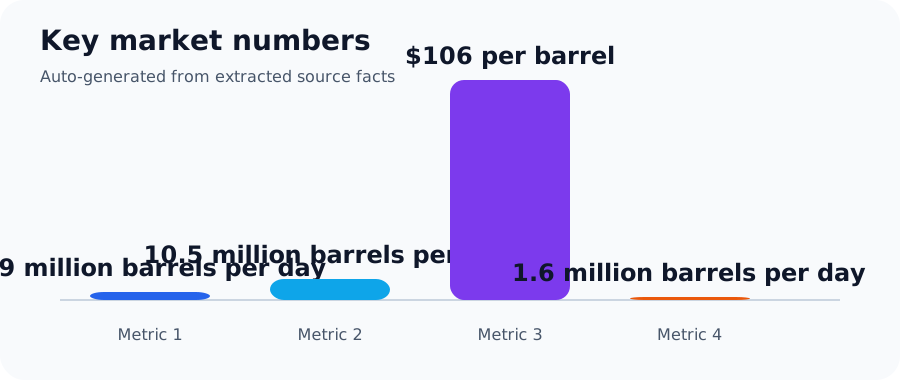
Investors are reacting to the speed and scale of this supply-side shock. While global demand is actually expected to contract by 420,000 barrels per day due to sluggish economic growth and high prices, this dip is insufficient to offset a projected 3.9 million barrel per day decline in total supply over the course of the year. The immediate result is a rapid drawdown of global inventories, which are falling by an average of 8.5 million barrels per day during the second quarter of 2026. This scarcity is keeping Brent crude prices anchored above the $100 mark, even as broader economic indicators suggest a slowdown.
The shift from surplus to a 1.78 million barrel deficit
The primary driver of current market sentiment is the IEA’s revision of the global oil balance. Earlier in the year, many analysts anticipated a comfortable surplus that would allow for a cooling of energy-driven inflation. However, the May report confirms that supply is now significantly trailing demand. The loss of 10.5 million barrels per day of Gulf production—stemming from a combination of infrastructure damage and geopolitical blockades—has created a hole in the market that other producers cannot easily fill.
The IEA notes that the supply decline is not a temporary blip but a sustained contraction. Total global supply is expected to drop by 3.9 million barrels per day throughout 2026. This deficit is particularly acute because it involves major producers including Iraq, Saudi Arabia, Kuwait, and the United Arab Emirates. When these core members of the global energy supply chain face output plunges of this magnitude, the market loses its "swing" capacity, leading to the $106 to $107 per barrel price floor currently observed in Brent crude.
The mechanism at play here is a classic supply-side squeeze. Even though "demand destruction" is occurring—evidenced by widespread flight cancellations and reduced consumer spending—the supply curve has shifted inward so aggressively that prices must remain elevated to ration the remaining barrels. This is why the market has not seen a significant sell-off despite weak economic data; the physical shortage of oil is simply too large to ignore.
Why markets care about the inventory drawdown
The most critical metric for short-term price action is the rate of inventory depletion. According to the IEA, global oil inventories are projected to fall by 8.5 million barrels per day during the second quarter of 2026. The steepest draws are occurring in May and June, which explains why Brent crude for July delivery has remained resilient, trading at approximately $107.50 per barrel despite minor intraday fluctuations.
Inventories act as the market's shock absorber. When they are drawn down at this velocity, the "buffer" against further disruptions disappears. This creates a high-volatility environment where even minor news regarding infrastructure or shipping can trigger outsized price moves. Traders are currently focused on the fact that these draws are not being driven by a sudden surge in consumption, but by a forced lack of production.
Furthermore, the location of these draws matters. With the Middle East and Asia-Pacific regions bearing the brunt of the production cuts, the geographical distribution of oil is becoming lopsided. This leads to localized shortages and spikes in regional benchmarks. As long as the inventory draw remains near the 8.5 million barrel per day mark, any significant downward trend in oil prices is unlikely, as the physical market remains extremely tight.
Refining bottlenecks and the downstream squeeze
While crude oil prices capture the headlines, the real-world impact is often felt most acutely in the refining sector. The IEA report indicates that global crude runs are expected to drop by 1.6 million barrels per day to an average of 82.3 million barrels per day for the year. More alarmingly, refinery throughput is forecast to fall by 4.5 million barrels per day in the second quarter alone.
This "downstream" squeeze is caused by severe feedstock shortages and physical damage to energy infrastructure. Operators in the Middle East and Asia are struggling to secure the specific grades of crude needed to produce essential fuels. The closure of the Strait of Hormuz has essentially cut off the primary artery for these refineries, leading to a shortage of:
- Naphtha: A critical feedstock for the petrochemical industry, impacting plastics and chemicals.
- LPG: Used for heating and industrial processes.
- Jet Fuel: Leading directly to the flight cancellations mentioned in the IEA report.
For investors, this means that the "crack spread"—the difference between the price of crude oil and the petroleum products extracted from it—is becoming a vital indicator. Even if crude prices were to stabilize, the cost of finished fuels could continue to rise if refinery throughput remains constrained. This affects every sector reliant on logistics, from e-commerce delivery to global aviation.
Inflationary pressures and the macroeconomic ripple
The persistence of oil prices above $100 has direct consequences for global inflation and central bank policy. Energy is a "core" input for almost every good and service. When the IEA forecasts a sustained deficit, it signals to markets that the "energy component" of inflation will remain "sticky" for longer than previously hoped.
The 420,000 barrel per day contraction in demand is a clear sign that high prices are starting to weigh on global growth. However, this is a "stagflationary" signal: growth is slowing (sluggish economic growth), but prices are remaining high because of supply constraints. This puts central banks in a difficult position. Raising interest rates to fight inflation may further dampen the already "sluggish" economic growth, but failing to act could allow high energy costs to seep into broader price expectations.
In the equity markets, this environment favors companies with strong pricing power and those in the energy upstream sector. Conversely, sectors with high energy intensity and low margins—such as traditional manufacturing and low-cost transport—are increasingly vulnerable. The fact that West Texas Intermediate (WTI) for June delivery is trading at $101.67 while Brent is at $107.50 also highlights a widening spread, reflecting the different supply dynamics between the North American market and the rest of the world.
What readers should watch next
As the market moves through the second half of 2026, several key indicators will determine whether the IEA’s deficit forecast remains the dominant narrative. Investors should prioritize the following signals:
- Strait of Hormuz Status: Any news regarding the reopening or further restriction of this waterway is the single most important factor for Gulf production. The current 10.5 million barrels per day offline figure is largely tied to this geographic bottleneck.
- Refinery Throughput Recovery: Watch for updates on infrastructure repairs in the Middle East and Asia. If refinery throughput begins to recover toward the 82.3 million barrel per day average, the shortage of jet fuel and naphtha may ease, even if crude remains expensive.
- Inventory Data Points: Weekly reports from the EIA (in the U.S.) and monthly updates from the IEA will confirm if the 8.5 million barrel per day drawdown is accelerating or slowing. A slower draw would suggest that demand destruction is finally catching up to the supply shock.
- OPEC+ Policy Shifts: While Iraq, Saudi Arabia, and the UAE are currently seeing output plunges, any diplomatic breakthrough that allows for a return of this production would immediately reprice the market.
The current market reaction is not based on speculation, but on a documented physical shortage of a primary global commodity. The transition from a surplus mindset to a deficit reality requires a fundamental shift in how risk is priced across all asset classes.
Final takeaway
The IEA’s May 2026 report serves as a stark reminder that supply-side constraints can override demand-side weakness. With a 1.78 million barrel per day deficit and a massive 8.5 million barrel per day inventory draw in the second quarter, the path of least resistance for oil prices remains upward or sideways at elevated levels. Investors should look past the daily price fluctuations of 0.3% or 0.5% and focus on the structural reality: the world is currently consuming more oil than it can produce and refine, and until Gulf production and the Strait of Hormuz return to normalcy, the energy market will remain a primary source of global economic friction.
This article is for educational purposes only and does not constitute financial advice.
How this shock is feeding into oil, inflation expectations, stock performance, bond yields, and the next signals investors should watch.
Stay ahead of the next move
If you found this useful, join the GrowthVisual newsletter for concise market briefings, key numbers, and the next signals to watch.
GrowthVisual Editorial Team reviews and publishes practical market analysis, calculator guides, and personal finance explainers.