How the Iran War Is Moving Oil, Stocks, and Bond Yields
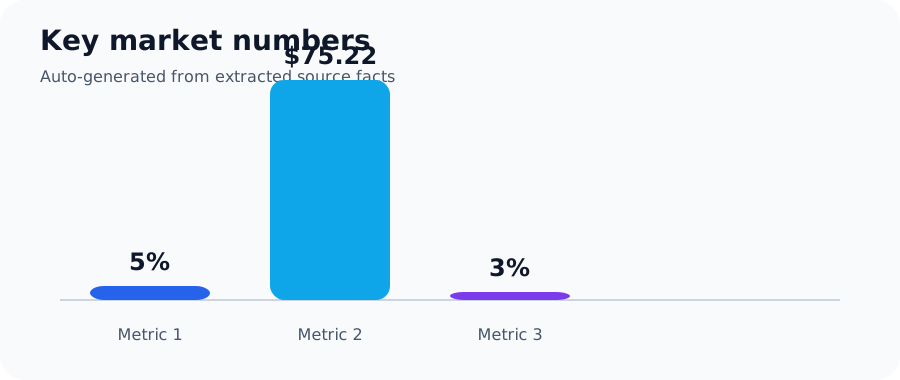
The escalation of conflict involving Iran has introduced a sharp pivot in global financial markets, disrupting a period of relative calm regarding inflation and interest rate expectations. As hostilities intensify, the immediate market response has been a repricing of energy risks, with U.S. oil prices surging more than 5% to reach $75.22 a barrel in recent trading. This spike is not merely a localized reaction to geopolitical tension; it represents a direct threat to the "soft landing" narrative that has supported equity valuations throughout the year.
The primary mechanism moving markets today is the repricing of inflation expectations. For months, investors had anticipated a steady decline in price pressures, allowing the Federal Reserve to pivot toward more aggressive rate cuts. However, the Iran war threatens to reverse this trend by driving up the cost of energy and transportation. With gas prices already jumping 11 cents to a national average of $3.11 per gallon, according to AAA, the risk of "inflation pass-through"—where higher energy costs bleed into the prices of groceries, airfares, and manufactured goods—has returned to the forefront of economic concern.
This shift is currently manifesting in three distinct ways: oil prices are factoring in a potential supply chokehold at the Strait of Hormuz; stocks are experiencing a rotation away from consumer-sensitive sectors toward energy and defense; and bond yields are reacting to the possibility that the Federal Reserve will be forced to keep interest rates higher for longer to combat a new wave of energy-driven inflation. While the broader economy has shown resilience, the duration of this conflict will determine whether these market moves are a temporary spike or a structural shift in the 2025 economic outlook.
Escalation in the Middle East and its immediate market reaction
The recent attacks involving Iran have triggered an immediate and calculated reaction across asset classes. According to a report by the Associated Press, U.S. oil prices rose more than 5% to $75.22 a barrel in afternoon trading following the onset of heightened hostilities. This move reflects the market's attempt to price in a "war premium" that had largely been absent from energy markets during the previous quarter. The suddenness of the price action underscores how quickly supply-side fears can override the demand-side concerns that had previously kept oil prices in check.
Beyond the raw price of crude, the impact reached American households almost instantly. Gas prices jumped 11 cents to an average of $3.11 a gallon nationwide. While this price remains lower than the peaks seen in previous years, the velocity of the increase is what concerns economists. A sudden 11-cent jump can dampen consumer sentiment and reduce discretionary spending, particularly for lower-income households that are already grappling with the cumulative effects of several years of elevated costs.
The equity markets have responded with increased volatility, though not a wholesale collapse. Investors are currently distinguishing between companies that can pass on higher energy costs and those that cannot. Transportation and logistics firms, which are highly sensitive to fuel prices, have faced immediate pressure. Conversely, the aerospace and defense sectors, along with domestic energy producers, have seen increased interest as they are perceived as hedges against geopolitical instability. This divergence suggests that the market is not yet pricing in a global recession, but rather a more difficult environment for inflation management.
The Strait of Hormuz and the energy supply chain
The most significant variable for the global economy is the security of the Strait of Hormuz. Located at the mouth of the Persian Gulf, this narrow waterway is the world's most important oil transit point. Approximately one-fifth of the world’s oil and natural gas is shipped through the Strait. Any disruption to this route would move the conflict from a regional issue to a global energy crisis.
Economists use a general rule of thumb to estimate the impact of oil on the broader economy: for every $10 increase in the price of a barrel of oil, U.S. inflation typically sees a measurable uptick. If the conflict lasts for several months and threatens shipping lanes, inflation could worsen significantly, potentially topping 3% for the first time since early 2024. The Associated Press reported that while a short-lived conflict might not derail the economy, a prolonged engagement would likely force a repricing of almost all consumer goods.
Natural gas is also a critical component of this supply chain. Even before the recent escalation, natural gas prices had risen 10% over the past year. This increase was driven in part by the massive energy demands of data centers powering artificial intelligence. A war-related spike in natural gas would further strain the power grid and increase utility costs for both industrial and residential users. Because natural gas is a primary feedstock for chemicals and plastics, higher prices in this sector have a "multiplier effect" that eventually raises the cost of everything from medical supplies to food packaging.
Inflation persistence and the Federal Reserve’s dilemma
The Iran war complicates an already difficult task for the Federal Reserve. The central bank’s preferred measure of inflation has been stuck at approximately 3% for roughly a year, despite the fact that gas prices had been falling steadily throughout 2024 and into 2025. This "sticky" inflation suggests that price pressures are deeply embedded in the service sector and housing. With energy prices now rising, the Fed faces the risk that inflation will move further away from its 2% target.
If energy costs continue to climb, the "pass-through" effect will become evident in other sectors. Higher jet fuel prices lead to higher airfares, and increased diesel costs lead to higher shipping rates for groceries and retail goods. This creates a secondary wave of inflation that is harder to control with interest rate policy alone. The Federal Reserve now finds itself in a position where it may have to pause its planned rate-cutting cycle to ensure that energy-driven inflation does not unanchor long-term inflation expectations.
For investors, this means the "higher for longer" interest rate environment may persist. Bond yields, particularly the 10-year Treasury yield, often rise when inflation expectations increase. Higher yields make borrowing more expensive for corporations and homebuyers, which can slow economic growth. The market is currently watching for any signals from Fed officials that indicate a shift in their assessment of inflation risks. If the central bank moves from a "dovish" stance back to a "hawkish" or neutral one, the impact on stock valuations—especially for high-growth tech companies—could be substantial.
Sector rotation and the shift in asset valuations
The financial impact of the Iran war is not uniform across the stock market. Instead, it is driving a significant rotation between sectors. Energy stocks are the most obvious beneficiaries, as higher crude prices directly improve the margins of exploration and production companies. However, the benefit to the energy sector is often offset by the drag on the broader S&P 500, where many companies are net consumers of energy.
The consumer discretionary sector is particularly vulnerable. When households spend more at the pump, they have less to spend on travel, dining, and retail. This is why stocks in the hospitality and automotive industries often see downward pressure during oil spikes. Furthermore, the industrial sector faces higher input costs. As noted by analysts, oil is a fundamental component in many industrial processes; as its price rises, profit margins for manufacturers begin to compress unless they can successfully pass those costs on to customers.
In the fixed-income market, the movement in bond yields is reflecting a "risk-off" sentiment combined with inflation fears. Initially, a geopolitical crisis often leads to a "flight to quality," where investors buy Treasuries, pushing yields down. However, in the current scenario, the inflationary impact of the war is competing with that flight to quality. If investors believe the war will lead to sustained 3% plus inflation, they will demand higher yields to compensate for the loss of purchasing power. This tug-of-war between safety-seeking and inflation-hedging is creating unusual volatility in the bond market, making it difficult for investors to find a stable "safe haven."
Key indicators for investors to monitor
As the situation evolves, there are specific metrics and signals that will indicate the severity of the financial fallout. The first is the duration of the oil price spike. A "spike and fade" pattern is common in geopolitical events, but if oil sustains a price above $80 or $90 for more than a month, the likelihood of a significant inflation print increases. Investors should monitor the weekly inventory reports and any statements from OPEC+ regarding production increases to offset Middle Eastern volatility.
The second indicator is the performance of the U.S. dollar. In times of global conflict, the dollar often strengthens as it is viewed as the world's reserve currency. While a strong dollar can help temper domestic inflation by making imports cheaper, it also hurts the earnings of U.S. multinational corporations when they convert foreign profits back into dollars. A rapidly appreciating dollar, combined with rising energy costs, would create a "double whammy" for large-cap stocks.
Finally, the market will be hyper-focused on the monthly Consumer Price Index (CPI) and Personal Consumption Expenditures (PCE) reports. Specifically, "core" inflation—which excludes volatile food and energy prices—will be watched to see if energy costs are bleeding into other categories. If core inflation begins to tick upward alongside headline inflation, it will be a signal that the Iran war has had a transformative impact on the domestic price structure, likely forcing a more restrictive monetary policy from the Federal Reserve.
Final takeaway
The conflict involving Iran has introduced a new layer of complexity to a global economy that was already struggling to reach its 2% inflation target. The immediate rise in oil to $75.22 and the jump in gas prices to $3.11 are clear signals that the era of falling energy costs may be over for the near term. For investors, the primary consequence is a shift in the interest rate outlook; the prospect of persistent 3% inflation makes aggressive rate cuts less likely and puts upward pressure on bond yields. While certain sectors like energy and defense may find support, the broader market must now contend with the reality that geopolitical risk has become a primary driver of domestic economic policy and consumer costs.
This article is for educational purposes only and does not constitute financial advice.
How this shock is feeding into oil, inflation expectations, stock performance, bond yields, and the next signals investors should watch.
Stay ahead of the next move
If you found this useful, join the GrowthVisual newsletter for concise market briefings, key numbers, and the next signals to watch.
GrowthVisual Editorial Team reviews and publishes practical market analysis, calculator guides, and personal finance explainers.