Why Oil Prices Are Rising and What It Means for Markets
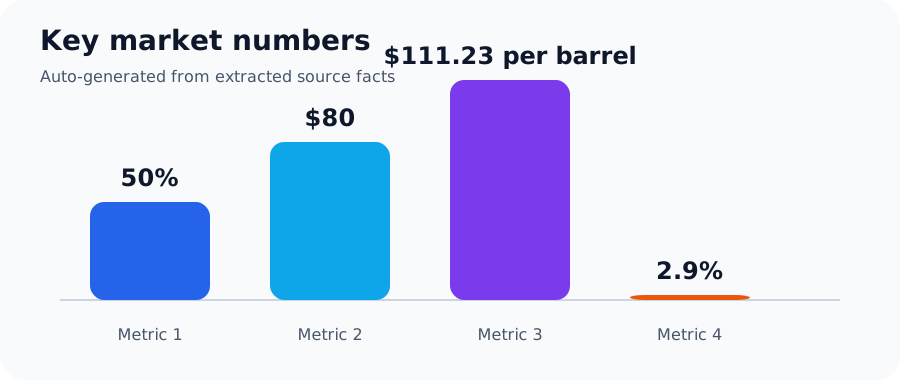
Oil prices have surged by more than 50% since the onset of the U.S.-Iran conflict on February 28, with international benchmark Brent crude recently hitting $111.23 per barrel and U.S. West Texas Intermediate (WTI) rising to $104.16. This rapid escalation is driven primarily by the disruption of the Strait of Hormuz, a critical maritime chokepoint through which approximately one-fifth of the world’s oil consumption passes. Analysts warn that if this passage remains restricted for an extended period, the global economy faces a supply deficit of roughly 10 million barrels per day, a gap that would require global demand to retreat to 2013 levels to maintain balance.
For investors, the primary concern is a growing disconnect between soaring energy costs and equity market performance. While oil prices have climbed steadily, the S&P 500 recently reached a new intraday record of 7,230.12, suggesting a period of "misplaced euphoria" where the broader market has yet to price in the full inflationary impact of an energy shock. This divergence is significant because higher-for-longer energy prices act as a regressive tax on both consumers and industrial producers, potentially forcing a "day of reckoning" for corporate earnings and central bank policy as the second quarter progresses.
The immediate cause of the rising oil prices is the physical restriction of supply and the heightened risk premium associated with Middle Eastern instability. Beyond the headline crude prices, the ripple effects are moving through the global economy via higher costs for liquefied natural gas (LNG), chemicals, and fertilizers. As energy becomes more expensive, the cost of production for virtually all physical goods increases, creating a persistent inflationary pressure that may prevent central banks from easing interest rates as quickly as the market currently anticipates.
What happened
The current volatility in the energy sector traces back to the escalation of the U.S.-Iran conflict in late February. Since the outbreak of hostilities, the energy market has undergone a structural shift, moving from a period of relative stability to one of acute supply anxiety. According to reports from cnbc.com, Brent crude’s rise to over $111 per barrel represents a 2.9% increase in a single session, reflecting the market's sensitivity to any news regarding the Strait of Hormuz.
The Strait of Hormuz is the central nervous system of the global oil trade. It is the only sea passage from the Persian Gulf to the open ocean, making it essential for exporters like Saudi Arabia, the UAE, Kuwait, and Iraq. Amrita Sen, founder and director of market intelligence at Energy Aspects, noted in a recent interview with CNBC that the "story is really when Hormuz reopens, and at what capacity and what pace it reopens." The scale of the disruption is difficult to overstate; a prolonged closure would effectively remove 10 million barrels of oil per day from the market. To put that in perspective, the world has added a billion people since 2013, the last time global demand was at a level that could be sustained without those 10 million barrels.
While OPEC has pledged to increase production to mitigate the shortfall, market analysts remain skeptical. Sen characterized these pledges as "largely symbolic," suggesting that the spare capacity available to OPEC members is insufficient to replace the volume lost through the Strait. This supply-demand imbalance has created a new price floor, with analysts now expecting $80 to $90 per barrel to be the baseline for the foreseeable future, even if the immediate conflict sees a de-escalation.
Why markets care
The primary reason financial markets are focused on oil prices is the historical correlation between energy shocks and economic recessions. When energy prices rise by 50% in a matter of months, it typically triggers a contraction in discretionary spending. However, the current market cycle is behaving atypically. The S&P 500’s climb to above 7,200 suggests that equity investors are either discounting the duration of the conflict or betting that the economy is resilient enough to absorb $110 oil.
This disconnect is what some analysts call a "conundrum." If oil prices remain at these elevated levels, the cost of transport, manufacturing, and heating will inevitably filter through to consumer price indices (CPI). For central banks, such as the Federal Reserve and the European Central Bank (ECB), this complicates the path toward lower interest rates. If inflation remains sticky due to energy costs, "higher-for-longer" interest rates become a necessity rather than a choice, which would eventually weigh on stock valuations and corporate borrowing costs.
Furthermore, the energy shock is not limited to oil. The price of LNG and other petroleum-derived products is climbing in tandem. This creates a secondary layer of risk for the industrial sector. When energy costs rise, profit margins for energy-intensive industries are squeezed. If companies cannot pass these costs on to consumers—who are already feeling the pinch at the gas pump—earnings will suffer. The "euphoria" currently seen in the stock market may be overlooking the fact that Q2 earnings are unlikely to match the strength of the previous quarter.
Who is most affected
The impact of rising oil prices is not distributed evenly across the global economy. Certain sectors and regions are significantly more vulnerable to sustained high energy costs.
- **Industrial and Chemical Sectors:** Companies involved in the production of chemicals and fertilizers are among the first to feel the impact. Natural gas and oil are primary feedstocks for these industries. Higher prices for these inputs lead to higher costs for agricultural fertilizers, which in turn drives up global food prices. This creates a "second-round" inflationary effect that is difficult for central banks to control through interest rate hikes alone.
- **European Economies:** Europe remains highly sensitive to energy imports. While the ECB is aiming to return inflation to its 2% target by June, a prolonged oil spike could derail this timeline. Holger Eisenschidt, an economist cited in the source report, suggested that while a swift resolution could allow the ECB to "look through" the spike, a lingering conflict would force a day of reckoning for European growth forecasts.
- **Asian Economies:** Many investors have dismissed the energy squeeze as a localized issue affecting Asian markets more than Western ones. However, as major importers of Middle Eastern crude, countries like China, India, and Japan are seeing their trade balances deteriorate. Because these nations are integral to global supply chains, their rising production costs eventually become higher import prices for Western consumers.
- **The Consumer Discretionary Sector:** For the average household, higher oil prices translate directly to higher gasoline and heating costs. This reduces the amount of "wallet share" available for retail, travel, and entertainment. If the new floor for oil is indeed $80-$90, the permanent loss of consumer purchasing power could lead to a broader slowdown in GDP growth.
Possible short-term financial impacts
In the coming months, the financial markets will likely transition from a state of optimism to one of critical assessment. The "misplaced euphoria" described by Energy Aspects suggests that a market correction could occur as the reality of higher energy costs hits corporate balance sheets.
One of the most immediate impacts will be seen in the transport and logistics sectors. Airlines, trucking companies, and shipping firms are all facing a sudden and sharp increase in fuel surcharges. While some of these costs can be hedged, long-term hedges eventually expire, forcing companies to face the spot market prices. This will likely lead to a downward revision of guidance for many transport-related stocks during the next earnings cycle.
In the bond market, the persistence of high oil prices may lead to a repricing of inflation expectations. If investors begin to believe that inflation will stay above 3% or 4% due to energy costs, bond yields will likely rise. Higher yields make borrowing more expensive for corporations and can lead to a rotation out of growth stocks and into more defensive sectors.
There is also the risk of a "demand destruction" event. As Amrita Sen noted, the market may actually *need* oil prices to go up further to force a reduction in consumption. If supply cannot be increased, the only way to balance the market is to make the product so expensive that people use less of it. This process is rarely smooth and often involves a sharp economic contraction—a recession—before prices stabilize.
What readers should watch next
As the situation evolves, there are several key indicators that will determine whether the global economy can avoid a deep recession.
First, the status of the Strait of Hormuz is the most critical variable. Investors should watch for any official announcements regarding the safety of transit and the volume of tankers passing through the waterway. Any sign of a permanent or long-term disruption will likely send oil prices toward $120 or higher, whereas a reopening could lead to a swift, albeit partial, retracement.
Second, watch for the "day of reckoning" in equity markets. If the S&P 500 begins to retreat from its record highs as Q2 earnings reports are released, it will be a signal that the market is finally pricing in the energy shock. Pay close attention to the commentary from CEOs in the manufacturing and retail sectors regarding their ability to manage input costs.
Third, monitor central bank rhetoric, particularly from the ECB and the Federal Reserve. If policymakers begin to shift their tone from "rate cuts are coming" to "inflation risks are tilted to the upside," it will indicate that energy prices are officially interfering with monetary policy goals. The June inflation data will be a pivotal data point in this regard.
Finally, keep an eye on OPEC’s actual production numbers rather than their pledges. If the cartel is unable to significantly increase the flow of physical barrels to the market, the $80-$90 "floor" for oil prices will likely become a permanent fixture of the economic landscape for the remainder of the year.
Final takeaway
The global economy is currently navigating a period of high uncertainty where the price of energy is at odds with the optimism of the financial markets. The 50% surge in oil prices since February is a structural challenge driven by geopolitical conflict and the disruption of vital supply routes like the Strait of Hormuz. While equity markets have remained resilient, hitting record highs, the underlying pressure of $110 Brent crude creates a significant risk of an inflationary "day of reckoning." Investors should prepare for a potential shift in market sentiment as the reality of higher-for-longer energy costs begins to impact corporate earnings and consumer spending. The path forward depends heavily on the duration of the supply disruption and the ability of global economies to adapt to a significantly higher energy price floor.
This article is for educational purposes only and does not constitute financial advice.
Why oil prices are rising, which sectors are most exposed, and what higher energy costs could mean for markets, inflation, and households
GrowthVisual Editorial Team reviews and publishes practical market analysis, calculator guides, and personal finance explainers.