
Iran Market Impact: Oil, Inflation, and Stocks to Watch
Geopolitical instability in the Middle East has historically served as a primary catalyst for financial market volatility, and the current conflict involving Iran is no exception. For investors, the Iran war market impact is most visible through the rapid appreciation of energy prices, which has disrupted a period of relative stability in global benchmarks. After trading within a narrow range of $60 to $70 per barrel for an extended period, Brent crude oil—the international benchmark for three-quarters of the world’s oil—surpassed the $100 threshold for the first time since the summer of 2022. This surge, which saw prices touch as high as $119, has fundamentally shifted the narrative for global equities and fixed-income markets.
The primary mechanism driving market resilience or vulnerability in this environment is the "energy-inflation-interest rate" loop. When oil prices spike, they act as a regressive tax on both consumers and corporations, increasing the cost of transport and manufacturing while simultaneously upwardly biasing inflation data. This inflationary pressure complicates the Federal Reserve’s policy path; while the central bank reduced rates three times at the end of last year, the current conflict-driven price shocks make further cuts difficult to justify. Consequently, the yield on the 10-year Treasury note has ballooned from 3.97% in late February to as high as 4.44%, creating a headwind for growth-oriented sectors like technology.
The shift from stability to volatility
Before the onset of the conflict, global markets were largely preoccupied with the long-term implications of artificial intelligence and domestic political developments. According to an AP News report, investors were focused on whether AI spending was sustainable or if certain industries would be rendered obsolete. This focus shifted abruptly as the war in Iran began to dictate daily market swings. The transition from a period of meandering growth to one of high volatility is best illustrated by the performance of the S&P 500, which recorded a drop of nearly 4.6%—its worst quarterly performance since 2022.
The speed of the transition caught many market participants off guard. Brent crude’s move from approximately $70 to over $100 per barrel represents a significant increase in input costs for the global economy. This is not merely a headline figure; it reflects a tightening of the physical oil market and a heightened "risk premium" as traders account for potential supply disruptions in the Strait of Hormuz or damage to regional energy infrastructure. The resulting uncertainty has led to frequent intraday swings in major indexes, as investors attempt to price in a conflict with an unknown duration and scope.
In the fixed-income market, the reaction was equally swift. The jump in the 10-year Treasury yield to 4.44% reflects a market that is pricing in "higher-for-longer" interest rates. When energy prices rise, the likelihood of inflation returning to the Federal Reserve’s 2% target diminishes. This forces bondholders to demand higher yields to compensate for the eroding purchasing power of future interest payments. For the broader stock market, these higher yields reduce the present value of future earnings, which is why the Nasdaq composite—heavy with technology and growth stocks—fell more than 10% from its October highs, entering what professional investors define as a "correction."
The energy-inflation transmission mechanism
The most direct way the Iran war market impact reaches the average household and business is through the fuel pump. While gasoline prices have soared, the impact on diesel is even more pronounced. Data from AAA indicates that the average price for a gallon of diesel has reached $5.45, a sharp increase from the $3.76 average recorded before the conflict began. Diesel is the primary fuel for the global freight and delivery network; when it becomes more expensive, the cost of moving goods—from groceries to construction materials—rises accordingly.
This creates a secondary wave of inflation known as "cost-push" inflation. Unlike "demand-pull" inflation, which is driven by a strong economy and high consumer spending, cost-push inflation is driven by rising production costs. For the Federal Reserve, this is a difficult scenario to manage. If the Fed cuts rates to support an economy slowed by high energy costs, it risks further fueling inflation. If it keeps rates high to combat inflation, it risks tipping the economy into a recession by making borrowing costs for businesses and consumers prohibitively expensive.
The source report notes that the Fed has kept rates steady this year following its year-end cuts. The current geopolitical climate has effectively frozen the central bank in place. Investors are now closely monitoring whether the "energy tax" will lead to a meaningful slowdown in consumer spending. In previous years, many Americans were paying under $3 for a gallon of gas; the move toward and beyond $4 in many regions represents a significant diversion of discretionary income away from other sectors of the economy, such as retail and travel.
Divergence in sector performance
While the broader market has struggled, the conflict has created a clear divergence in sector performance. Energy stocks have emerged as one of the few areas of strength within the S&P 500. This is a logical outcome, as higher crude prices directly translate to higher top-line revenue and wider margins for exploration and production companies. For investors, energy has functioned as a "geopolitical hedge," gaining value precisely when the rest of the portfolio is under pressure due to rising risk sentiment.
Conversely, the technology sector has faced a dual threat. First, as mentioned, higher Treasury yields make the high valuations of tech companies harder to justify. Second, the "AI-mania" that dominated the early months of the year has been tempered by the reality of a more difficult macroeconomic environment. When the Nasdaq composite enters a correction, it suggests that investors are moving away from "risk-on" assets and toward more defensive postures.
Other sectors feeling the weight of the conflict include:
- **Transportation and Logistics:** Airlines and trucking companies are seeing their primary operating expense—fuel—spike, leading to earnings revisions and downward pressure on stock prices.
- **Consumer Discretionary:** Companies that rely on "extra" household income are vulnerable as more money is diverted to basic necessities and fuel.
- **Utilities:** Often viewed as a safe haven, utilities can sometimes struggle when bond yields rise rapidly, as their dividends become less attractive compared to "risk-free" government debt.
Possible short-term financial impacts
In the short term, the primary concern for the financial system is the potential for a "liquidity shock" if the conflict escalates further. When uncertainty is high, investors tend to move toward cash and gold, which can lead to rapid sell-offs in even high-quality stocks. We have already seen the S&P 500 endure its worst quarter in two years, and further volatility is expected as long as the duration of the war remains unclear.
For the average saver, the impact is felt through the erosion of purchasing power. If inflation remains elevated due to energy costs, the "real" return on savings accounts and certificates of deposit (CDs) may turn negative, even if nominal interest rates are relatively high. Furthermore, the jump in mortgage rates—which track the 10-year Treasury yield—has further cooled the housing market, making it more expensive for new buyers to enter and for existing homeowners to move.
Corporate earnings will be the next major test. As companies report their quarterly results, analysts will be looking for mentions of "margin compression" caused by energy and logistics costs. If companies are unable to pass these costs on to consumers, profit forecasts will likely be trimmed, which could lead to another leg down for the stock market. However, if the labor market remains resilient and consumer spending holds up despite the fuel price hike, the market may find a floor near current levels.
What readers should watch next
As the situation evolves, there are three specific indicators that will signal whether the market impact is stabilizing or worsening. First is the price of Brent crude relative to the $120 mark. If oil sustains a move above $120, it increases the probability of a global economic slowdown, as this level has historically been a "breaking point" for consumer demand.
Second, investors should watch the "spread" between different types of bonds. If the gap between corporate bond yields and Treasury yields begins to widen significantly, it suggests that the market is becoming worried about the ability of companies to repay their debts in a high-interest-rate environment. This "credit stress" is often a precursor to deeper market corrections.
Third, the rhetoric from Federal Reserve officials will be critical. Any shift in language regarding the "balance of risks"—moving from a focus on inflation to a focus on economic growth—would signal that the central bank is becoming more concerned about a recession. Until such a shift occurs, the market is likely to remain in a "higher-for-longer" interest rate regime, which favors value stocks and energy over high-growth technology.
Final takeaway
The Iran war market impact has fundamentally reordered investor priorities, moving the focus from technological optimism to geopolitical reality. With Brent crude oil hovering near $100 and the Nasdaq in correction territory, the "peace dividend" that markets enjoyed for much of the previous year has evaporated. The immediate consequences are clear: higher costs for consumers at the pump, increased pressure on corporate margins, and a Federal Reserve that is constrained by sticky inflation. While energy stocks provide a temporary refuge, the broader health of the market depends on whether energy prices stabilize and whether the global economy can absorb the current price shocks without entering a significant downturn.
This article is for educational purposes only and does not constitute financial advice.
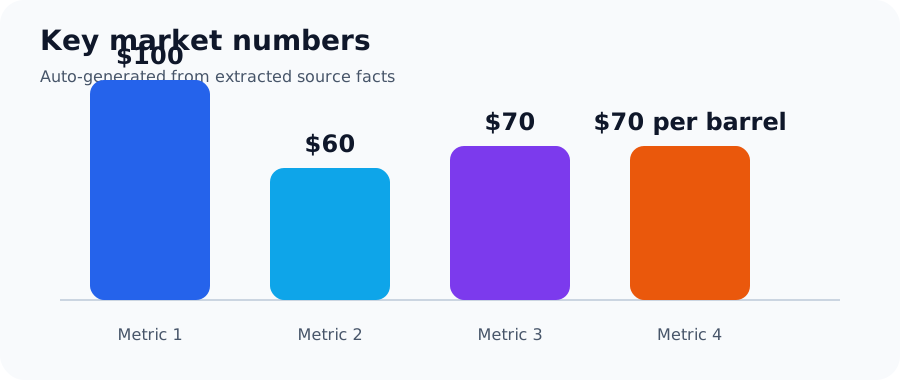
How Iran-related market tension could affect oil prices, inflation, stocks, and household finances, plus what to watch next
GrowthVisual Editorial Team reviews and publishes practical market analysis, calculator guides, and personal finance explainers.