How the Iran War Is Moving Oil, Stocks, and Bond Yields
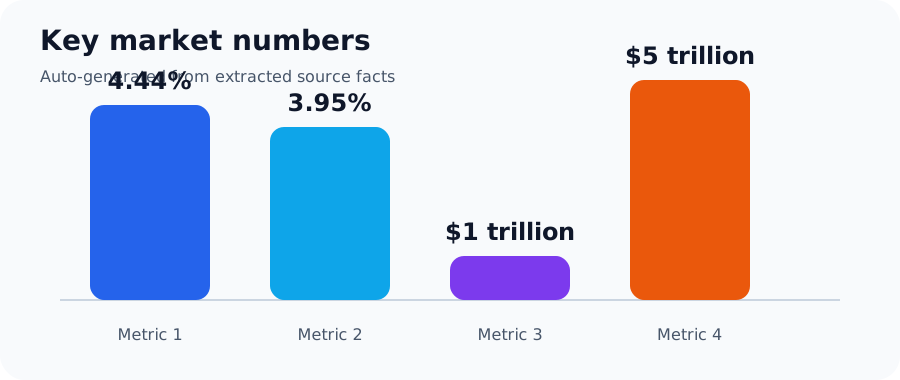
The outbreak of conflict involving Iran at the end of February has triggered a significant repricing of risk across global financial markets. This shift is most visible in the bond market, where the yield on the 10-year U.S. Treasury note has climbed from 3.95% prior to the conflict to over 4.44%. This movement reflects a dual concern among investors: the immediate inflationary pressure of rising energy costs and the long-term fiscal stability of the United States as it navigates a more volatile geopolitical landscape.
The primary mechanism driving these market moves is the "inflation pass-through" from energy prices into broader consumer costs, combined with a "term premium" adjustment in the bond market. As the war disrupted energy supply chains, oil prices spiked, leading investors to demand higher yields to compensate for the eroding purchasing power of fixed-income assets. Simultaneously, the market is pricing in the reality of a U.S. government that must borrow more at higher rates to fund its operations and service a national debt that now costs more than $1 trillion annually to maintain.
In the short term, this has created a challenging environment for stocks and rate-sensitive sectors. While energy companies have seen some benefit from higher crude prices, the broader equity market is grappling with the prospect of "higher-for-longer" interest rates. Mortgage rates have reached nine-month highs, and consumer-facing sectors like the automotive industry are seeing a slump in sales as financing becomes prohibitively expensive for many households.
The immediate shift in energy and bond markets
The start of the Iran war in late February served as a catalyst for a sharp reversal in the downward trend of interest rates that many analysts had expected for 2025. According to data reported by the Associated Press, the 10-year Treasury note surged past 4.44%, a level that has fundamentally changed the math for corporate borrowing and consumer lending. This upward trajectory peaked in mid-May, with rates hitting 4.67% before easing slightly as news of potential ceasefire negotiations surfaced.
This volatility in yields is directly tied to the energy market. Iran’s role in regional oil production and its proximity to the Strait of Hormuz mean that any escalation in conflict introduces a "war premium" to crude prices. When energy costs rise, they act as a tax on both consumers and businesses, raising the cost of transportation, manufacturing, and heating. The bond market reacts to this by pricing in higher inflation expectations, which forces the Federal Reserve to maintain a restrictive policy stance, keeping yields elevated.
The relationship between the war and bond yields was further complicated by domestic policy. Earlier in 2025, the implementation of "Liberation Day" tariffs by the Trump administration had already begun to push rates higher. The onset of the war compounded these inflationary pressures. Kent Smetters, faculty director of the Penn Wharton Budget Model, noted that approximately 40% of the recent increase in 30-year Treasury yields can be attributed to inflation driven by the combination of the Iran war and these tariffs. The remaining 60%, however, stems from a more structural concern: the expectation of continued outsized government borrowing.
Why markets care about the fiscal feedback loop
Beyond the immediate price of a barrel of oil, the financial community is focused on the sustainability of the U.S. fiscal position. The cost of servicing the national debt has tripled since 2021, now exceeding $1 trillion per year. Jessica Riedl, a budget and tax fellow at the Brookings Institution, pointed out that the tax cut bill signed by President Trump is projected to add $5 trillion to 10-year deficits. While the administration has argued that tariffs would cover these costs, Riedl noted that they are currently offsetting only a small fraction of the deficit increase.
Investors are sensitive to this "debt-to-GDP" trajectory because it influences the "risk-free rate" that serves as the benchmark for all other assets. If the market perceives that the government is borrowing too much to fund both domestic programs and geopolitical engagements, it demands a higher yield to hold that debt. This creates a feedback loop: higher yields increase the cost of servicing existing debt, which in turn widens the deficit, requiring even more borrowing.
Treasury Secretary Scott Bessent has attempted to calm these fears by announcing a goal to reduce the annual deficit to 3% of the overall U.S. economy. To achieve this, the administration is pointing toward a 2024 report from the Government Accountability Office (GAO) which estimated that fraudulent government spending ranges between $233 billion and $521 billion annually. Bessent suggested that eliminating this fraud could substantially reduce the $1.8 trillion annual budget deficit. However, the market remains skeptical of whether these administrative savings can be realized quickly enough to offset the inflationary pressures of the war and the cost of expanded fiscal policy.
Who is most affected by the current market volatility
The rise in bond yields has immediate, real-world consequences for American households and specific sectors of the stock market. The most direct impact is felt in the housing market. As Treasury yields rise, mortgage lenders increase their rates to maintain their margins. With average mortgage rates hitting their highest levels in nearly a year, the "affordability gap" has widened, pricing out many first-time homebuyers and slowing the pace of home sales.
The automotive sector is also experiencing a significant cooling effect. Most car purchases are financed, and as interest rates on auto loans climb in tandem with bond yields, the monthly payment for a new or used vehicle has risen beyond the reach of many consumers. This has led to a slump in auto sales, which serves as a leading indicator of broader consumer discretionary spending. When households spend more on debt service—whether for mortgages, car loans, or credit cards—they have less available for other goods and services.
In the equity markets, the impact is uneven. Technology and growth stocks, which are highly sensitive to interest rates because their valuations are based on future earnings, have faced headwinds. Conversely, the energy sector has seen localized gains, and some financial institutions may benefit from wider net interest margins. However, the overall sentiment is one of caution. The "risk-off" environment triggered by the war has led many investors to rotate out of speculative assets and into "safe havens," though even traditional safe havens like Treasuries are being re-evaluated due to the rising deficit concerns.
Possible short-term financial impacts and policy responses
In the coming months, the interplay between the Iran war and U.S. economic policy will likely center on the administration's "fraud task force," led by Vice President JD Vance. President Trump has suggested that if this task force is successful in unlocking massive savings from fraudulent spending, the government could move toward a balanced budget without further drastic measures. While this is an optimistic projection, the financial markets will be looking for concrete evidence of these savings in the quarterly budget updates.
Another area of focus will be the "Liberation Day" tariffs. As seen earlier in the year, when the administration backed off the most extreme tariff increases, Treasury rates began to decline. If the war in Iran persists, the administration may face pressure to adjust its trade policy to mitigate the total inflationary burden on the economy. The market is currently pricing in a scenario where the administration must choose between its protectionist trade goals and the need to keep inflation—and therefore interest rates—under control.
Furthermore, the midterm elections represent a significant variable. Rising interest rates and declining affordability are traditional liabilities for an incumbent party. If the bond market continues to signal high inflation and fiscal instability, it may force a pivot in rhetoric or policy as the November elections approach. Investors should expect continued volatility in the "belly" of the yield curve (the 2-year to 10-year notes) as market participants try to guess whether the Federal Reserve will be forced to hike rates further or if the administration will successfully implement deficit-reduction measures.
What readers should watch next
The most critical factor for the immediate future is the status of ceasefire negotiations in the Iran conflict. As seen in mid-May, even the prospect of a de-escalation was enough to pull the 10-year Treasury rate down from its 4.67% peak. A formal cessation of hostilities would likely lead to a "relief rally" in both stocks and bonds, as the energy-driven inflation threat would diminish.
Investors should also monitor the monthly reports from the Treasury Department regarding debt issuance and the cost of servicing that debt. If the $1 trillion annual interest expense continues to climb, it may trigger further "term premium" adjustments, meaning long-term interest rates could stay high even if the Federal Reserve eventually decides to cut short-term rates.
Finally, keep a close eye on the GAO’s updated figures on government spending and the progress of the Vance-led fraud task force. For the administration to meet its goal of a 3% deficit-to-GDP ratio, it will need to find significant and verifiable savings. Any gap between the promised savings and the actual budget numbers will likely be met with higher yields in the bond market, as investors demand a higher "credibility premium" for lending to the U.S. government.
Final takeaway
The Iran war has acted as a powerful "macro catalyst," exposing the vulnerabilities of an economy already grappling with high debt and trade-related inflation. By driving the 10-year Treasury yield toward 4.5%, the conflict has tightened financial conditions for every American, from the homebuyer to the corporate treasurer. While the administration points to fraud reduction and tariffs as the solution to the deficit, the bond market’s reaction suggests that investors are more concerned with the immediate reality of energy-led inflation and the long-term cost of servicing a $34 trillion debt load. Moving forward, the path of interest rates—and by extension, the health of the stock and housing markets—will depend as much on diplomatic developments in the Middle East as it does on fiscal discipline in Washington.
This article is for educational purposes only and does not constitute financial advice.
How this shock is feeding into oil, inflation expectations, stock performance, bond yields, and the next signals investors should watch.
Stay ahead of the next move
If you found this useful, join the GrowthVisual newsletter for concise market briefings, key numbers, and the next signals to watch.
GrowthVisual Editorial Team reviews and publishes practical market analysis, calculator guides, and personal finance explainers.